CERN KiCad Libraries: The High-Quality Open-Source Component Library Every PCB Designer Should Know
When designing printed circuit boards (PCBs), choosing the right component library is just as important as selecting the right schematic or routing strategy. High-quality schematic symbols, accurate footprints, and consistent naming conventions can save countless hours while reducing costly manufacturing mistakes.

For KiCad users, one of the most valuable resources available today is the CERN KiCad Libraries. Developed and maintained by the electronics engineers at CERN—the European Organization for Nuclear Research—these libraries are now available as open source for the entire electronics community.
Whether you're designing embedded systems, robotics projects, FPGA development boards, or industrial electronics, CERN's libraries provide a professional-grade foundation that has already been proven in demanding scientific applications.
What Are CERN KiCad Libraries?
CERN is home to some of the world's most advanced scientific instruments, including the Large Hadron Collider (LHC). Building and maintaining these systems requires thousands of custom electronic boards with extremely high standards of quality and reliability.
To support this work, CERN developed a comprehensive component library for electronic design. Rather than keeping these resources private, CERN has released them to the public under the CERN Open Hardware Licence v2, allowing engineers, students, hobbyists, and companies to benefit from the same libraries used in cutting-edge scientific research.
The project is hosted on GitLab and is actively maintained:
Repository:
https://gitlab.com/ohwr/cern-kicad-libs
Why These Libraries Stand Out
Many freely available KiCad libraries are community-created, which often means quality can vary from one component to another. Symbols may use inconsistent naming, footprints may contain errors, or 3D models may be missing altogether.
CERN's libraries are different because they are built for professional engineering environments where mistakes can be extremely expensive.
Some of their biggest advantages include:
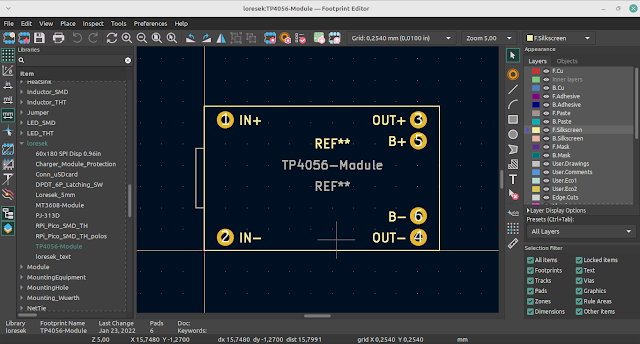
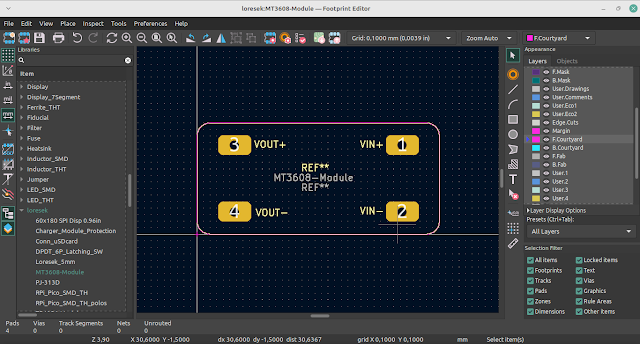
Production-Quality Symbols and Footprints
Every symbol and footprint is intended for real engineering work rather than demonstration projects.
This means consistent:
Pin naming
Pin numbering
Mechanical dimensions
Courtyard definitions
Silkscreen placement
Assembly information
Using professionally maintained libraries greatly reduces the chance of PCB manufacturing errors.
Automatically Generated from Altium Libraries
One particularly interesting aspect of the project is that these KiCad libraries are generated automatically from CERN's internal Altium component database.
This ensures that both design environments remain synchronized without manually maintaining two separate libraries.
The automation also reduces human error and keeps every component definition consistent across different CAD platforms.
Nightly Updates
Unlike many static libraries that remain unchanged for years, CERN's KiCad libraries are updated automatically every night.
As new components are added or existing parts are improved, users can benefit from continuous improvements without waiting for occasional major releases.
This makes the libraries feel like a living project rather than an archived download.
Database-Driven Library Management
Managing thousands of electronic components manually quickly becomes impossible.
CERN uses a database-driven workflow where component information is stored centrally and automatically converted into KiCad libraries.
This approach improves:
Consistency
Version control
Scalability
Component traceability
Long-term maintenance
For organizations managing large hardware projects, this is an excellent example of modern engineering practice.
Compatible with KiCad 9 and KiCad 10
Another major advantage is compatibility with current and future versions of KiCad.
The project supports KiCad 9 while also preparing for KiCad 10, allowing engineers to adopt newer software versions without rebuilding their component libraries from scratch.
Licensed Under CERN Open Hardware Licence v2
One reason many engineers hesitate to use third-party libraries is uncertainty about licensing.
Fortunately, CERN distributes these libraries under the CERN Open Hardware Licence Version 2, making them suitable for open-source hardware development while providing clear legal terms for reuse and modification.
Always review the license documentation to ensure it matches your project's requirements, especially for commercial products.
Ideal Applications
Because these libraries originate from a world-leading scientific research institution, they are suitable for a wide range of hardware designs.
Some excellent use cases include:
Embedded Systems
Microcontroller boards often contain dozens or even hundreds of components.
Reliable symbols and footprints make it much easier to design:
STM32 boards
RP2040 projects
ESP32 devices
ARM Cortex-M systems
IoT hardware
FPGA Development Boards
FPGA designs frequently use fine-pitch BGAs and high pin-count devices where footprint accuracy is essential.
Using professionally maintained libraries can significantly reduce design risk.
Robotics
Robotics projects combine sensors, motor drivers, communication interfaces, and power electronics.
A dependable component library helps maintain consistency across increasingly complex schematics.
Industrial Electronics
Industrial systems demand high reliability and long product lifetimes.
The quality standards reflected in CERN's libraries make them a strong starting point for industrial PCB development.
Scientific Research Hardware
Naturally, these libraries are also ideal for laboratory equipment, measurement instruments, and custom scientific electronics.
After all, they were created specifically for this type of work.
Custom PCB Projects
Even hobbyists can benefit from professional libraries.
Instead of searching multiple websites for individual footprints, designers gain access to a unified collection maintained using professional engineering practices.
Benefits for KiCad Users
Integrating CERN's libraries into your KiCad workflow offers several practical advantages.
You can spend less time verifying footprints and more time focusing on the actual circuit design.
Because the libraries are maintained consistently, projects also become easier to share with teammates.
If you're developing multiple boards over several years, using standardized component libraries helps maintain compatibility and simplifies long-term maintenance.
In addition, engineers moving from commercial EDA tools may appreciate the professional structure and organization that these libraries provide.
Should Every KiCad User Install Them?
Not every project requires an extensive component library.
If you're designing a simple LED flasher or a one-off prototype, KiCad's default libraries may already be sufficient.
However, if you regularly design custom PCBs or work on professional hardware, CERN's libraries are definitely worth exploring.
Their emphasis on quality, consistency, and automation reflects the same engineering practices used to build electronics for some of the world's most sophisticated scientific experiments.
Even if you don't end up using every component, studying how the libraries are organized can provide valuable insight into professional component management.
Final Thoughts
Open-source hardware continues to grow, and
projects like the CERN KiCad Libraries demonstrate how major research organizations can contribute valuable resources to the global engineering community.
Instead of starting every project from scratch or relying solely on community-maintained components, KiCad users now have access to a professionally developed library that has been created for demanding scientific applications.
With production-quality symbols and footprints, automated generation from CERN's Altium database, nightly updates, database-driven management, compatibility with modern versions of KiCad, and an open hardware license, this project represents one of the highest-quality component libraries currently available for KiCad.
If PCB design is part of your workflow—whether you're building embedded systems, FPGA boards, robotics platforms, industrial controllers, research equipment, or your own custom electronics—the CERN KiCad Libraries deserve a place in your toolbox.